U.S. Department of Justice, Office of Justice Programs; National Institute of Justice The Research, Development, and Evaluation Agency of the U.S. Department of Justice U.S. Department of Justice, Office of Justice ProgramsNational Institute of JusticeThe Research, Development, and Evaluation Agency of the U.S. Department of Justice

Getting Ready: Transcript of Dora Schriro Discussing Remaking Prison Life to Prepare Inmates for Reentry

Listen to the interview.

Part 1 of 4: The Getting Ready Program — An Overview

Nancy Ritter: Let's just start from an overview of Getting Ready, and then we can drill down more to the components of the program, and particularly I think the thing that intrigued me and the reason I wanted to do this was the Parallel Universe from your delivery at the NIJ conference.

Dora Schriro: I think to talk about Getting Ready is, is to talk about a system-wide reform.

I've been fortunate to have been in the field of corrections for a very long time, and, and there are some things that never seem to change. The good inmate — quote/unquote, good — was all too often a really lousy ex-offender. Because the good inmate is that man or woman who sat on their bunk, kept their nose down, stayed out of trouble, took any order that was given to him or her by anybody at any time for any reason, just low profile, did their time.

And then with that set of skills, when you go back to the street and all you know how to do is sit on your bunk all day and take orders from anybody, it becomes pretty clear that you are exceptionally ill-equipped to be either civil or productive because the minute you meet up with anybody that you knew from the streets before or met out on the streets now, as quick as they said, "hey, let's go somewhere and go do this" or "let's go get high" or "let's go knock over the package store," whatever it is they're saying, well, you just take their direction the way you took direction inside.

It is a system that takes adult men and women, clearly imperfect in their decision-making, but takes away from them any opportunity to make decisions. And so they continue to avoid any responsibility, any accountability for their prior bad acts or their current conduct.

Our reform is bottoms-up and system-wide. It succeeds because what we do in our bottom-up, system-wide reform is to identify the many responsibilities that should be and are today shifted from staff to inmates.

As an example, officers and others don't wake up the population. They don't tell them when to get up, and they don't tell them when to go to sleep.

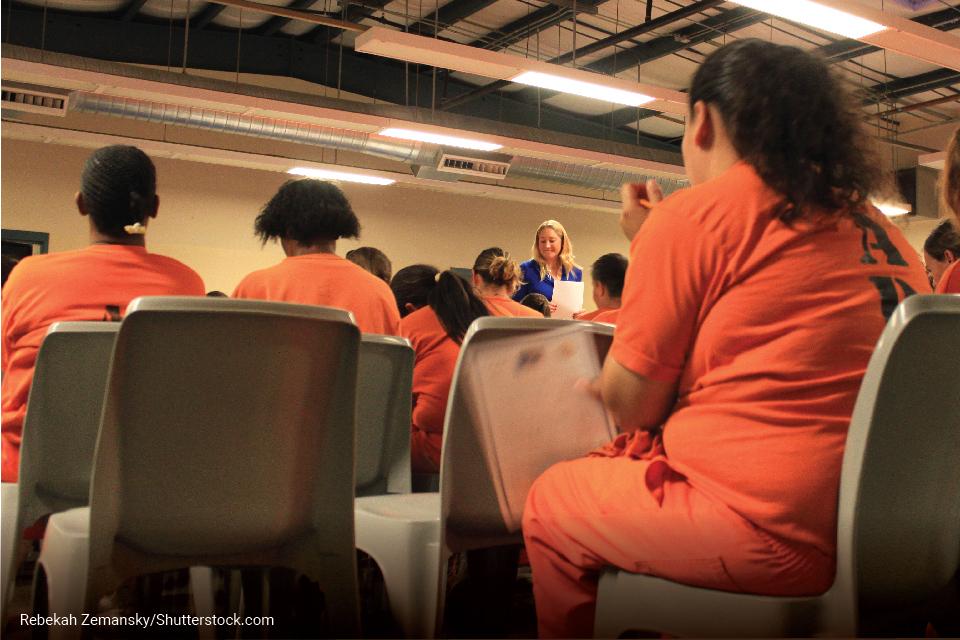
And so in our environment, we don't just preach about what you ought to be doing when you get back to the real world. We bring the real world, a Parallel Universe, into prison so that the population apply those skills throughout their incarceration, not just the couple hours a day that they're in one or another program service, but every minute of every day.

Ritter: And how do you indoctrinate them?

Schriro: Well, it's at the point now where the inmates are our best emissaries. We don't rely solely on inmates, but the inmates are so excited about the opportunity to excel that they, both formally and informally, provide an overview.

In our intake process, which is one of the four facets of the Five-by-Five, there are formal orientations, and those conversations continue through the development of the individualized corrections plans.

So, let me explain a little bit about how it works. The whole of our initiative is called Getting Ready because it focuses on the 97 percent of any state's correctional system that is sentenced to a term of years and then goes home at some point in time. But it is equally applicable to those who are there for life, either serving life or sentenced to death.

But the population — from the moment they walk in, there's an assessment. It's a series of objective evaluations to ascertain what their risk is at this point in time, as well as what their needs are. And that process is repeated at least annually throughout the incarceration. All of the information that is distilled from those normed evaluations is then translated into an individualized corrections plan.

Getting Ready is fundamentally a very practical and very pragmatic endeavor because we struggle with scarce resources, as does every other system I've ever encountered.

We identify not only what an inmate needs to address, these criminogenic factors, before they're released to the street, but we are clear through our assessments what's the correct dosage, that is, what's the frequency and the intensity of the service that needs to be delivered. And then given the scarce resources and the prioritization of which skills are necessary to acquire before you can move on to the next set of skills, then these opportunities are staged through the incarceration. So we don't necessarily commit that everyone is going to get everything they need within the first couple weeks or year that they're incarcerated, but that they will be afforded these opportunities well before they're released back to the street.

So in my mind it's kind of like everyone goes to the same supermarket and everyone gets a cart, but as you go down the aisles, you take those things off the shelf that meet the needs of your family. Well, so it is. We have these shelves that are stocked with evidence-based endeavors, but you can't just open up any package and sample it as you go. We will make sure that there is adequate stock for you to be able to take those things that are indicated as being necessary for your growth and development.

One of the things that I think is refreshing and in addition to Getting Ready, is we focus, of course, on what needs to get done during the workday, you know, the school, the job training, the treatment, as well as traditional work opportunities, whether they're in prison or out on the street. But we spend as much time and attention on leisure hours.

What all of the recidivism studies tell us is even if you get a job or acquire some other skills, there's still all this free time in your life. And so learning how to make good decisions and use your leisure time wisely is every bit as important to your long-term success as what you do during the workday.

And so, inmates are also very actively involved in structuring the leisure time. And so, if you're waiting to get into drug treatment or you've completed drug treatment but you still have these addiction issues, what you do in leisure time, not as part of the workday but as leisure time, is you sign up for an AA program or you participate in the gym where you improve wellness, which helps to fortify your notions about staying sober and, and being straight. So there's substantive conversation about how you put together the whole of your day, not just traditional treatment programs. And it's also why we say that this is a 24/7 operation because it's what you do and how you do it every minute of every day.

Next section: Part 2 — Working With Inmates, Staff and the Community.

Date Modified: May 29, 2009